
Dr. Jerry Sanson
Louisiana Maneuvers and Military Museum
October 2025
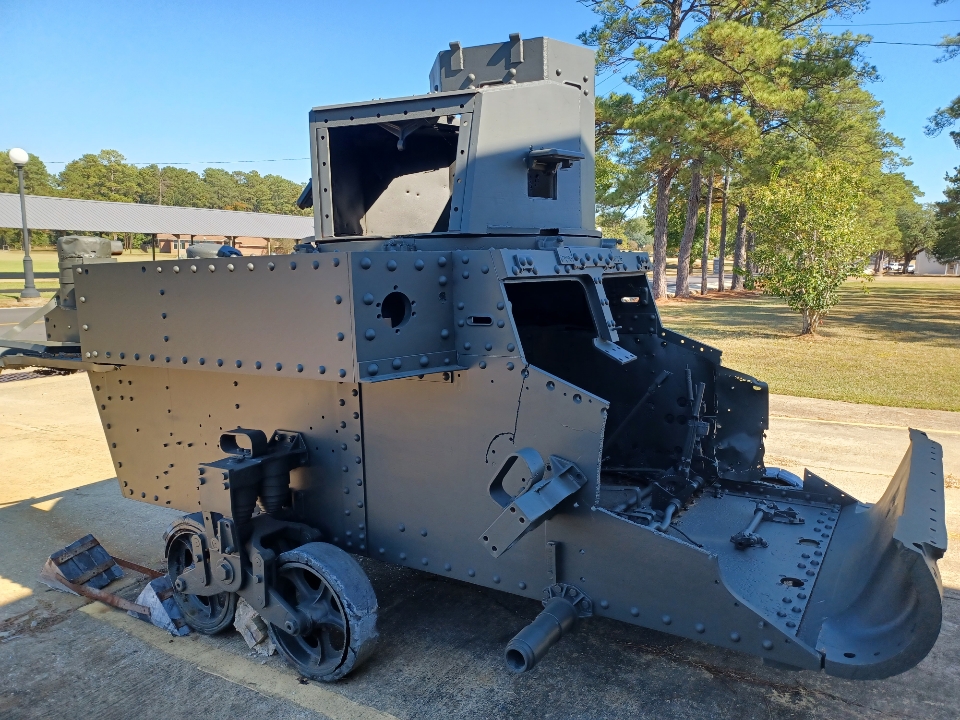
The development and use of tanks during World War I opened a new arms race in which the United States fell behind during the post-war years. The U.S. fell so far behind that Poland was able to field approximately 700 armored vehicles when German tanks rolled across its border on September 1, 1939, while the United States armored force that morning numbered about 400 useable vehicles, not counting its obsolete World War I era tanks, according to Steve Zaloga, author of Stuart: U. S. Light Tanks in Action.
One of the problems that contributed to this situation was that the Army did not seem to know what to do with tanks’ capabilities. The Army disbanded the Tank Corps when World War I ended, and tanks were placed under the control of the infantry. The thought behind this move was based on the thought that tanks should serve the needs of infantry by removing machine gun nests and other obstacles in the walking rifleman’s way. Others in the Army, however, realized that tanks could become a mechanized version of horse cavalry and fulfill the Army’s need for scouting, pursuit, and exploitation.
According to the terms of the National Defense Act of 1920, only the infantry could have tanks, so a small experiment of allowing the cavalry to have armored vehicles had to be hidden. The cavalry could not have tanks, but it could have “combat cars,” which looked and operated remarkably like tanks.
The Army spent the limited amount of money in its budget for tank development during the 1930s on light tanks simply because they were cheaper to build. The result was that the American Army depended on light tanks until 1942 when demands caused by combat against a truly effective German tank corps led to the development of medium and heavy tanks during World War II.
The infantry and cavalry depended on four different designs by 1939. The infantry developed the M2A2 and M2A3 twin turret design tanks while the cavalry used M1 and M1A1 single turret combat cars. All four designs were obsolete by European standards at the start of the European Theater of Operations, but they served as a foundation for design and construction of the Stuart tank.
The four pre-war designs evolved into the M2A4 manufactured by the American Car & Foundry Company during 1940 and 1941 and the Baldwin Locomotive Works during 1942, but it was a transition model to the Stuart.
The Stuart was built using design elements from the M2A4 with armor upgraded to 1½ inches and was designated as the M3 in June 1940. The British received M3s as part of the Lend-Lease program and first used them in the North Africa Campaign. They nicknamed the original M3 design as the “Honey” because of its maneuverability and reliability even though they were not happy with the firepower of the main gun (37mm.) “Popcorn balls thrown by Little Bo Peep would have been just as effective” against German armor, grumbled one British tanker. The Stuart’s other primary drawback was its limited range—only 75 miles without auxiliary fuel supply.
British reports of battle experiences, American experience in battle in the Philippines after the Japanese invasion in December 1941, and additional work by American tank designers led to several improvements to the Stuart including an improved turret, addition of an Oil Gear traversing motor, improvements in periscopes, addition of a gyro stabilizer for the 37mm main gun, and additional modifications that enhanced effectiveness. The modified tank, designated M3A1, entered production in May 1942.
M3s and M3A1s were used in both Theaters of World War II but some military historians maintain that they were probably more effective in the Pacific where their small size made them more suitable for jungle warfare. They were used until the end of the war, but their role changed into reconnaissance and flank security as heavier M3 Lee/Grants, M4 Shermans, and M26 Pershings assumed combat roles at various times during the war.
The role of the Stuart tank is commemorated today at the Stuart Tank Memorial Association Museum in Berwick, Pennsylvania, near the location where American Car & Foundry manufactured more than 15,000 Stuarts during World War II. The last one left the factory in April 1944. The museum has an M3A1 version in restored and running condition and another on display in the museum building. Board members plan to construct a Stuart Tank Memorial at the museum site honoring those who built them and those who served as their crews during the war.
The Louisiana Maneuvers and Military Museum’s M3A1 currently awaits transfer from the Collection Center to a new pad constructed by the Corps of Engineers in the Vehicle Park where it will become a permanent part of the static outdoor exhibit.