
Jerry Sanson
Louisiana Maneuvers and Military Museum, April 2026
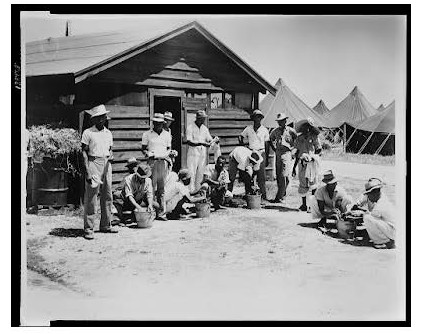
American farmers experienced increasing trouble during World War II finding enough workers to complete the work necessary for them to grow food and fiber that they needed to produce for the war effort. New or expanded businesses offered higher incomes and often better working conditions than the farmers could offer.
They tried to address this problem in several ways. Mechanization crept onto farms in the form of more tractors, harvesters, and other machinery. POWs filled in for absent laborers. People who had never worked in agriculture, or who had not worked in the fields in years, and high school students received short training sessions before volunteering to help farmers grow needed crops.
Farmers also turned to foreign countries for help. The United States Department of Agriculture authorized 75,000 temporary farm workers from Bahamas and Jamaica to ease the agricultural labor shortage in 1943. They worked on farms mainly along the East coast. Their presence was tempting to Louisiana farmers who needed help in their fields because some of them were housed at the U. S. Naval Air Station at New Orleans, but climate and the traditional southern social practice of segregation kept them unavailable.
The Jamaican government insisted on two conditions before agreeing to send workers to the United States: the workers had to return to Jamaica after the 1943 harvest season concluded so they would not be exposed to the cold temperatures of a harsh North American winter, and they could not be used in the South where they would endure the indignities of a segregated society.
The presence of extra labor led some south Louisiana farmers to ask Louisiana U.S. Senators Allen Ellender and John Overton to prevail on the federal government to seek changes in the agreement with Jamaica. The War Food Administration subsequently asked the Jamaican government to extend the workers time of employment and to allow them to be used to complete the sugar cane harvest in Louisiana and Florida because the cane harvest typically extended beyond the time for other crops.
Despite the pleas from Louisiana cane farmers, however, the Jamaican government agreed for its citizens to remain in the United States over the winter of 1943-44 but with the stipulation that they could only be used in Florida, where the climate more closely matched the warmer temperatures of Jamaica.
The failure of Louisiana farmers to obtain Jamaican workers left POWs held in the state as the best remaining pool of available labor and helped lead to their utilization in the state’s sugar cane fields.