
Author: Dr. Jerry Sanson, Louisiana Maneuvers & Military Museums, Pineville
Louisiana experienced several labor disputes during World War II, but two stand out as the largest and bitterest of the war years. The first began with a walkout staged by the International Brotherhood of Electrical Workers (IBEW) against Gulf States Utilities (GSU) in 1941. The union claimed that GSU dominated the Gulf States Electric Employees’ Association (GSEEA) with which it negotiated working conditions. Union representatives claimed that the GSEEA was a company union that did not properly represent workers. The resulting strike led to numerous charges and counter-charges between the two antagonists and apparent sabotage of a transformer in Ascension Parish that resulted in a massive blackout in Baton Rouge and the surrounding area.
The National Labor Relations Board (NLRB) settled the dispute in February 1942, ruling that GSU had acted properly when it negotiated with the GSEEA, which it held to be a legitimate union, rather than with the IBEW. The other major strike affected production at Louisiana’s biggest and most important war production facility, the massive Higgins Industries shipyards in New Orleans, builders of the famous Landing Craft Vehicle Personnel more commonly known as Higgins Boats.
Andrew Jackson Higgins, owner of Higgins Industries, described a cozy relationship between workers and management at the company when he testified before the Senate Special Committee Investigating the National Defense Program (the “Truman Committee”) in 1943, but that friendly relationship disappeared in late 1944 in a dispute over “hot ships” complicated with efforts by the Congress of Industrial Organizations (CIO) to supplant the American Federation of Labor (AFL) representing Higgins workers.
Great Lakes shipbuilders held contracts for about 100 ships for the military as the winter of 1944-45 approached, and Navy officials requested that they be transferred to ice-free areas for completion so production would not be delayed. Higgins agreed to build a portion of them in New Orleans. The United States Maritime Commission (USMC) classified the work as “new construction” and authorized Higgins to pay workers time-and-a-half for any overtime work they performed on the ships. Unions representing Higgins employees classified the work as ship repair or conversion and demanded double wages for overtime hours. The USMC refused to allow Higgins to pay the higher wage scale, and union leaders ordered their members not to work on the “hot ships.”
Their order prevented Higgins Industries from receiving 30-50 ships for completion, and company officials notified the unions that their contracts would not be renewed on January 1, 1945. The CIO complicated the situation by asking for an election to determine whether it or AFL unions should represent Higgins workers.
Higgins’ troubles continued into 1945. The unions charged that his company hired ex-service members without requiring them to join a union. Company officials announced that they were preparing a list of names of striking workers eligible for the draft to send to General Raymond Fleming, Selective Service Director in Louisiana (and three-time Adjutant General of the Louisiana National Guard). The War Labor Board ordered strikers back to work, but they did not return until union leaders informed them that Army and Navy officials had told them that the strike deprived the services of badly-needed equipment.
The approaching end of war contracts gave Higgins additional leverage in the dispute. The company announced on 16 August 1945 that it would begin converting back to civilian production and that about two-thirds of current workers would be laid off, many of them permanently. Troubles flared again on 29 October when union members claimed that Higgins locked them out and declared an open shop. Higgins announced later that he planned to close his remaining shipbuilding plants and start over with a new company. This plan did not work for him and continued labor disputes eventually led him to abandon shipbuilding.
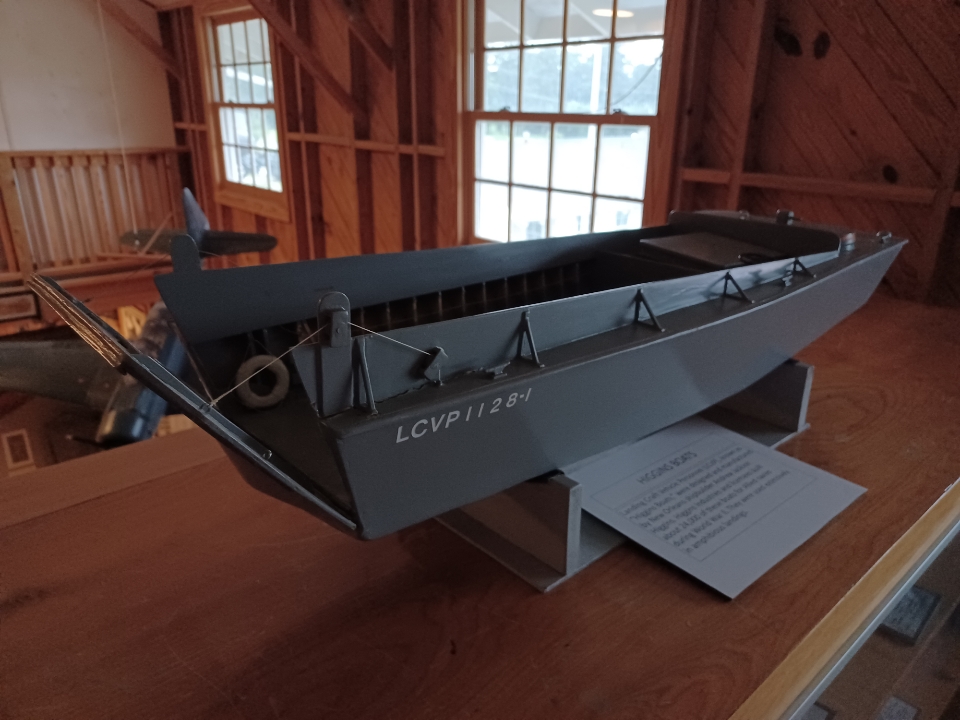
The model Higgins Boat displayed in the Louisiana Maneuvers and Military Museum serves as a reminder of one of Louisiana’s important manufacturing contributions to the war effort and of the necessary cooperation between workers and management to ensure that United States military forces had the equipment they needed to fight the war.