
Jerry Sanson
Louisiana Maneuvers and Military Museum
February 2026
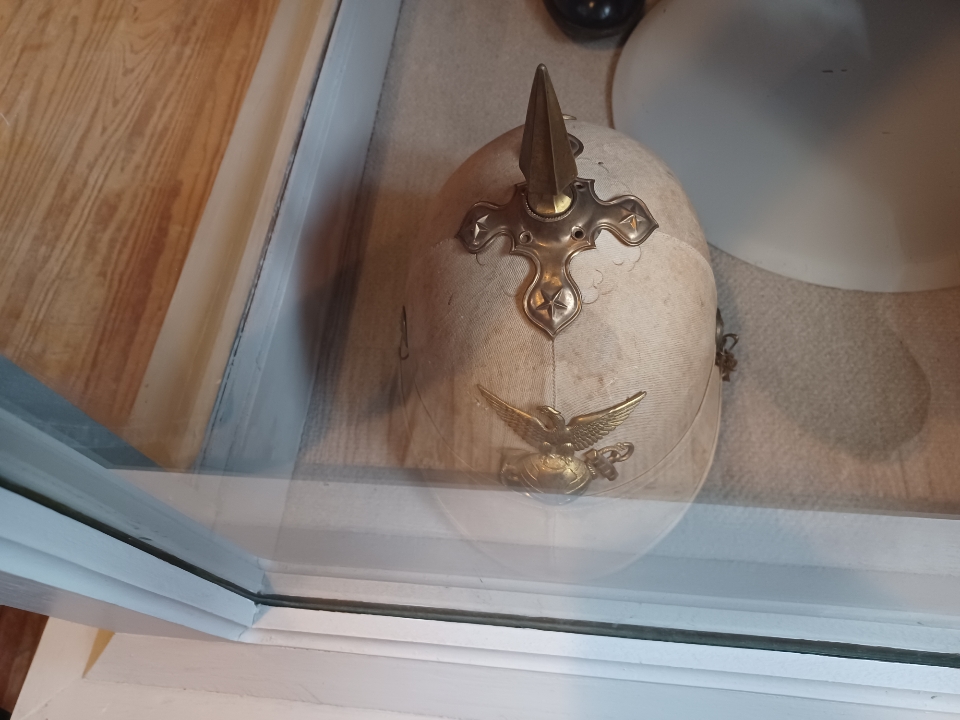
Military museums across the country, including the Louisiana Maneuvers and Military Museum, display American Army uniforms from the late nineteenth and very early twentieth century eras complete with helmets that have a sharply pointed metal spike on top. Visitors sometimes comment that the helmets are similar to German helmets that they have seen, and they are correct—the United States Army, along with many other armies in other parts of the world, wore spiked helmets during the time period that looked as though they belonged on the heads of Prussian or German soldiers. The spiked American helmets on display in the Museum illustrate a step in the evolution of American military uniforms.
The spiked helmet is a very old piece of military equipment. Excavations have found examples dating to ancient armies, but where did this recent iteration originate, and how did it become a part of uniforms in different parts of the world?
Most accounts indicate that Russia revived the practice of wearing spiked helmets based on pointed helmets of the Middle Ages in 1841. Russia also fought five wars with Persia between 1651 and 1828 for control of Caucasus, Armenia, and Georgia, with Persia occasionally becoming a Russian client state. Persian soldiers wore helmets that were pointed or spiked on top and modeled after helmet designs from the east. Some military historians believe that the Persian influence led Russians to adopt the style.
The British fought a series of wars in India from the 1760s until 1849 when they established control of the subcontinent, and Indian soldiers also wore pointed helmets based on earlier designs from the east. The British military subsequently adopted spiked helmets.
Germans became forever identified with the spiked helmet, or pickelhaube, in 1842 when King Friederich Wilhelm IV of Prussia
decided that his army would wear it. The subsequent German army continued to use the design until 1916.
The United States adopted the spiked helmet as part of the evolution of military headgear. The U.S. military generally followed French styles until the late nineteenth century even though there were exceptions. The South Carolina Palmetto Riflemen Militia, for example, used a spiked helmet as early as the antebellum period and the Civil War. The Riflemen were of German ancestry, however, to the point of printing their rule book in both English and German. It is not surprising that they used a German-style helmet.
One explanation of why the U.S. military adopted the spiked style holds that the United States was a relatively young country in the late nineteenth century and did not want to be seen as out-of-step when countries such as the United Kingdom, Spain, Norway, Portugal, Romania, Argentina, Mexico, and others all over the world had adopted the latest style in military uniforms.
Some military historians hold with another explanation—that the United States followed French styles from the Revolutionary era until Prussia’s resounding victory during the Franco-Prussian War in 1871. Prussia appeared to be the rising military power in Europe, so why not copy a winner?
World War I ended combat use of the spiked helmet. The spike’s original purpose was to deflect downward sword strokes, but it offered no protection against shrapnel created by modern weapons used in trench warfare.
The United States military had time to experiment with different style helmets because of delayed entry into the war, but the pressure of deployment once the country entered the conflict led the military to adopt the British Mark I, later modified into the American Model 1917, the famous “Doughboy” helmet that many people associate with American troops in the war.
The Model 1917 became standard issue, and it remained in use until the beginning of World War II. The U.S. military continued
experimenting with different models of helmet during the interwar years including one that developed into the M1, the iconic World War II headpiece. The M1 was the first modern helmet designed as a two-piece model featuring a lightweight liner that could be separated from the steel shell. The shell could then be used as a wash basin, kettle for warming water, cooking pot to warm rations in the field, emergency digging implement, and other uses discovered by inventive GIs. The United States manufactured about 22 million of them during World War II, used them in every theater