Jery Sanson
Louisiana Maneuvers and Military Museum
July 2026

Cadillac is a name in American automobile history that conjures a certain image of luxury, of floating down the highway ignoring the potholes, of arriving at the opera house or the country club dressed in your finest attire. Perhaps you envision the infamous 1959 El Dorado Biarritz with its towering tailfins, the highest ever on a Detroit production car, and its twin bullet taillights. Maybe you think of special use vehicles—limousines, hearses, and in earlier times, ambulances. Whatever you envision, Cadillac has been part of the American road since 1902.
The powerful and durable engines that made Cadillacs useful as ambulances subjected to severe use for prolonged time periods at high speeds also made the brand useful during World War II. Other luxury brands such as Packard and Lincoln contributed to the war effort as well, and they as well as non-luxury brands, switched from producing consumer automobiles and trucks to manufacturing tanks, other military vehicles, engines, and parts for Allied forces when President Franklin Roosevelt’s War Production Board directed them to do so in February 1942.
Cadillac’s business relationship with the military during World War II began in 1939 when it started producing precision parts for General Motors Allison Division’s V-1710 aircraft engine that powered P-38 Lightnings, P-51 Mustangs, and P-63 Kingcobras. Meticulous engineering was a natural job for a company created out of the financial ruins of Henry Ford’s second company in 1902 by Henry Leland. Leland’s obsession with precision manufacturing led him to insist on the same precise engineering and production that he demanded in Cadillac manufacturing when he founded Lincoln Motor Company in 1917. Cadillac also built more than 12,000 V-8 engines for armored vehicles that it made as well as engines for vehicles manufactured by other companies.
The company earned the coveted Army-Navy “E” Award for Excellence for its significant manufacturing achievements in war equipment production. Its output was considerable. For example, it is credited with producing almost 11,000 tanks and armored vehicles and about 12,000 engines for various uses.
That output included M5 and M5A1 Stuart tanks, M75mm and M19 Twin 40mm Gun Motor Carriages, and M24 Chaffee light tanks.
The mighty Flying Tigers Volunteer Group achieved some of the few Allied successes in the early war helping protect China from attacks by the Japanese Air Force, and that fact gives the company a tangential connection to Louisiana because the Curtiss P-40 Warhawks that the Flying Tigers used were powered by engines manufactured by Allison Division using parts supplied by Cadillac. Retired Army Air Corps officer Claire Chennault, who grew up in northeast Louisiana and always claimed it as his home, recruited, trained, and commanded the Flying Tigers.
Also, coastal patrol squadrons hunting German submarines in the Gulf of Mexico to protect the coast and approaches to the Mississippi River used the same Cadillac engine as the Warhawks. Even the most ardent Ford or Chrysler fans in Louisiana relied on boats powered by Cadillac for part of their protection during the war, even though they probably did not know at the time.
World War II was not the first time Cadillac contributed to an American war effort. The Jackson Barracks Museum exhibits a green 1918 Type 57 Cadillac staff car from the World War I era. The Type 57 is historically important in its own right because it was the first mass-produced automobile with a V-8 engine. It became a relatively common sight on the battlefields of Europe after the U.S. military requisitioned numerous Type 57s during World War I because of a shortage of dedicated military transport.
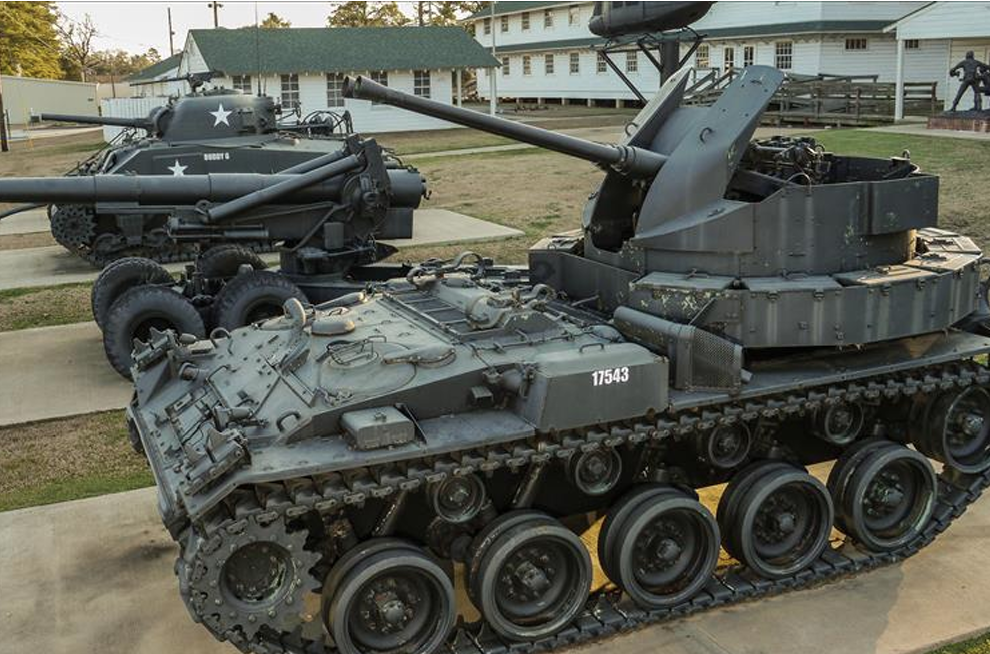
Cadillac’s World War II contributions are commemorated by the M19A1 “Duster” Self-Propelled Anti-Aircraft Gun Motor Carriage built by Cadillac and powered by two Cadillac Model 44T24 V8 engines exhibited at the Louisiana Maneuvers and Military Museum.