Jerry Sanson
Louisiana Maneuvers and Military Museum
August 2026
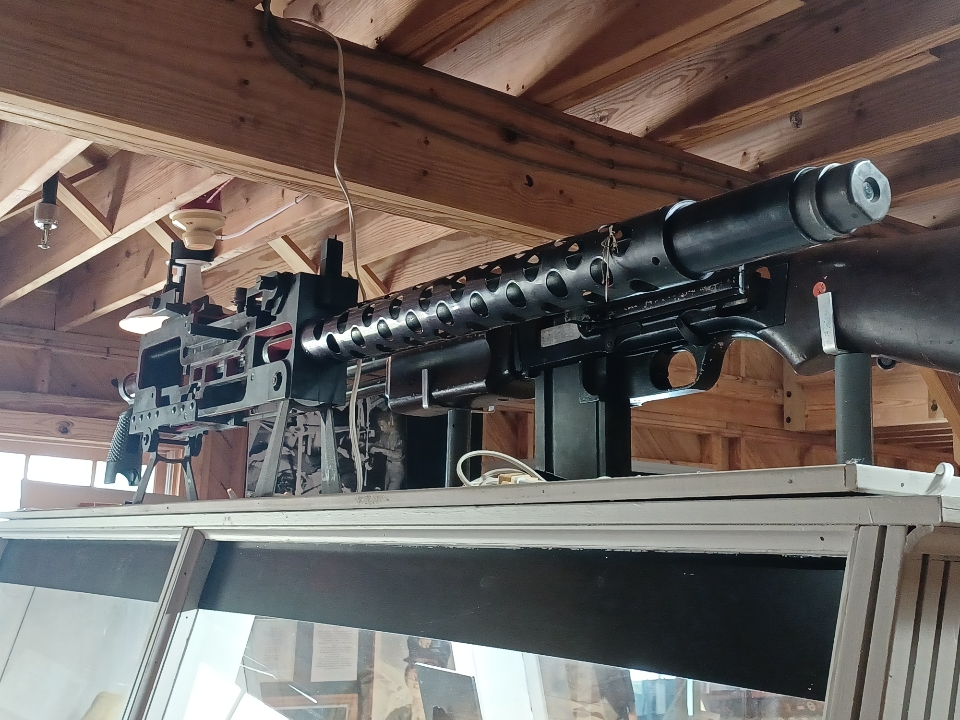
One of the exhibits in the Louisiana Maneuvers and Military Museum that seldom fails to catch the attention of visitors includes two radically oversized weapons displayed atop a World War II artifacts case. Members of school field trip tours are especially impressed with guns that would be taller than most of them if stood on their stocks. We explain that the weapons were not manufactured to fire bullets, but they were intended to help the Army train its soldiers.
The Army faced an unprecedented training problem during World War II. It had to train hundreds of thousands of civilians with little or no military background how to live under military rules, form an effective fighting force, and maneuver through the countryside effectively to win battles. Part of that training included learning as much as possible about the operation and care of weapons.
Trainers used both old-school lectures and demonstrations as well as comics, cartoons, educational films, posters, and other aids to convey important information to the troops. In fact, the use of instructional films in Louisiana classrooms began when school administrators and teachers learned of their effective use in the maneuvers and training camps in the state during the war.
Army instructors also used giant fake weapons that exactly copied the appearance and operation of actual weapons that soldiers would use on the battlefield as another training aid. The weapons were constructed of aluminum to save weight and improve maneuverability. Simulated ammunition was made of plastic. Even though they looked formidable, they were manufactured to be incapable of firing.
The advantage of using props of this size was that large numbers of troops could be taught at one time what happened internally to fire a bullet when they pulled the trigger on such a weapon. Perhaps just as importantly, they could also be taught in mass how to dismantle the weapon, clean it, and reassemble it for its next use.
Use of oversized weapons for teaching began in 1943 when the Army and the Naval Research Special Devices Center created “Device 3-F-3,” a non-firing large-scale model of the M1918A2 Browing Automatic Rifle. It was made from parts twice the size of those used in the battlefield version.
Later additions to the training weapons cache included giant demonstration models of the M1/M2 carbine, Browning 1919 machine gun, and M1 Garand semi-automatic rifle respectively designated as M21, M22, and M24.
The Army used oversized weapons for training from the mid-1940s until the late 1950s when changes in weapons technology made them no longer useful.
The Louisiana Maneuvers and Military Museum displays two of the giant training weapons, a Browning M1918A2 and a Browning M1919 machine gun.