
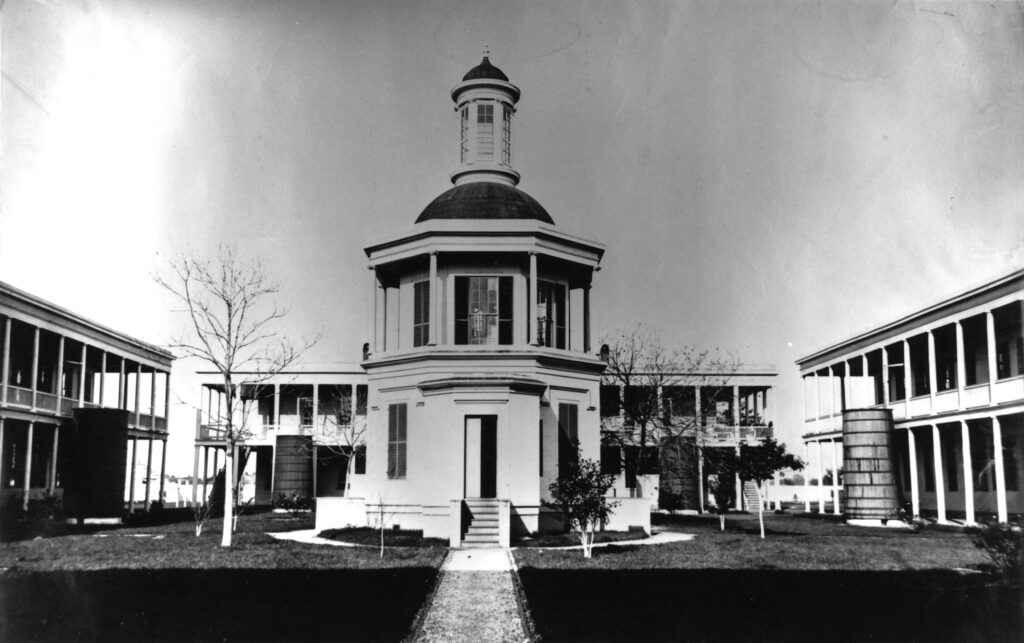
Hospital 1849
This section of the post represents the purchase of 88 additional acres in the 1848 expansion of the post. During the Mexican American War, the government decided a military hospital was needed so adjacent land was purchased from Mr. Prudence Desilets and a hospital complex constructed in 1849.
Four hospital wards could accommodate 800 – 1,000 patients. In the center, an octangle structure was intended for surgery and a dispensary. “The while arrangements of this hospital are on a scale far beyond any other work of the kind in the country” (New Orleans Weekly Delta, 5 Mar, 1849). Within 7 months the surgery center and all 4 wards had leaking roofs.
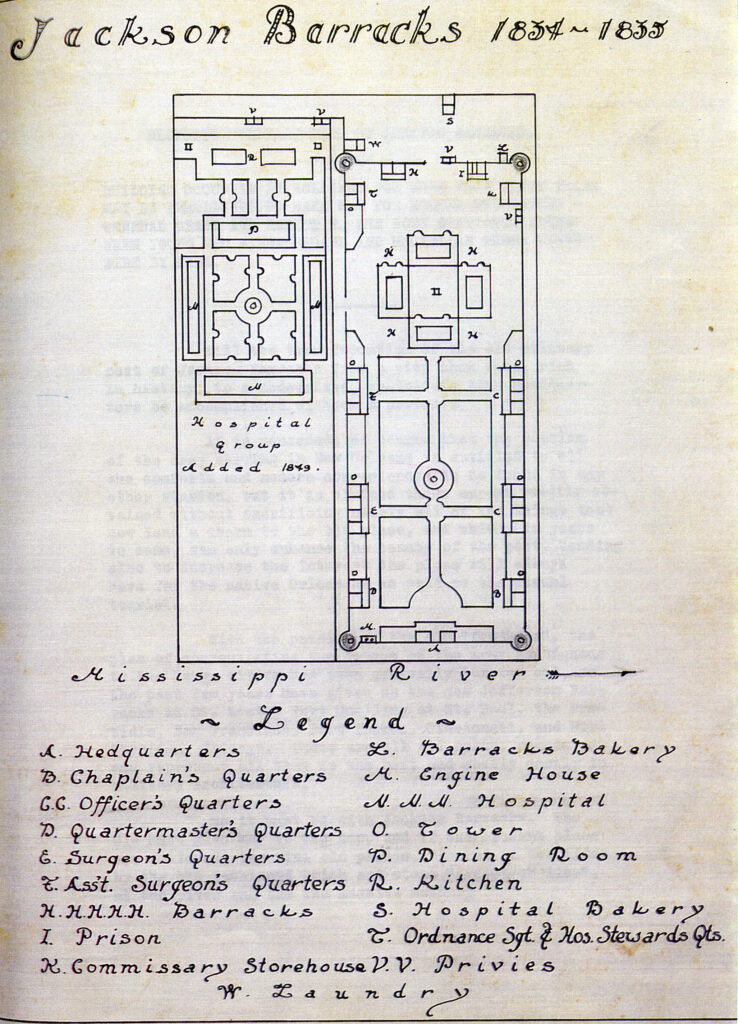
In the early 1850s, the garrison was reduced to the minimum personnel assignment, and the wards and all available buildings were used as a marine hospital due to the intervention of US Army Engineer MAJ PGT Beauregard. At that time, the number of merchant marine and river men was higher than ever before or since (Times Democrat 1 May 1905 in WPA v353 p40). It also served as an early attempt to house disabled veterans. The project was quickly moved to another location in Washington DC.
In 1861, an explosion at the Marine Hospital on the west bank resulted in a transfer of recovering Confederate Soldiers to the Jackson hospital facility. Union Soldiers continued to use the hospital after they took control of the city in May of 1862.

In 1867-68 a cholera epidemic resulted in 659 patients and nearly 200 deaths.
By the 1890s the hospital complex had been torn down and a new hospital building (now Hufft Hall) constructed in 1891.

A Sally Port is a secured entranceway in a fortified structure. This is the most obvious of the remaining portions of the original enceinte (perimeter wall – another being next to NE tower). About 12’ high. While not thick enough to defend against artillery, the thick walls did adequately protect against small arms fire expected in situations of civil unrest or slave revolt.
When the hospital land was purchased in 1848, a sally port was added to the original west wall. The wall was eventually taken down, but the sally port remains today. The indented area of the brickwork on the east side indicates where the doors hung while open.