Jerry Sanson
Louisiana Maneuvers and Military Museum
September 2026
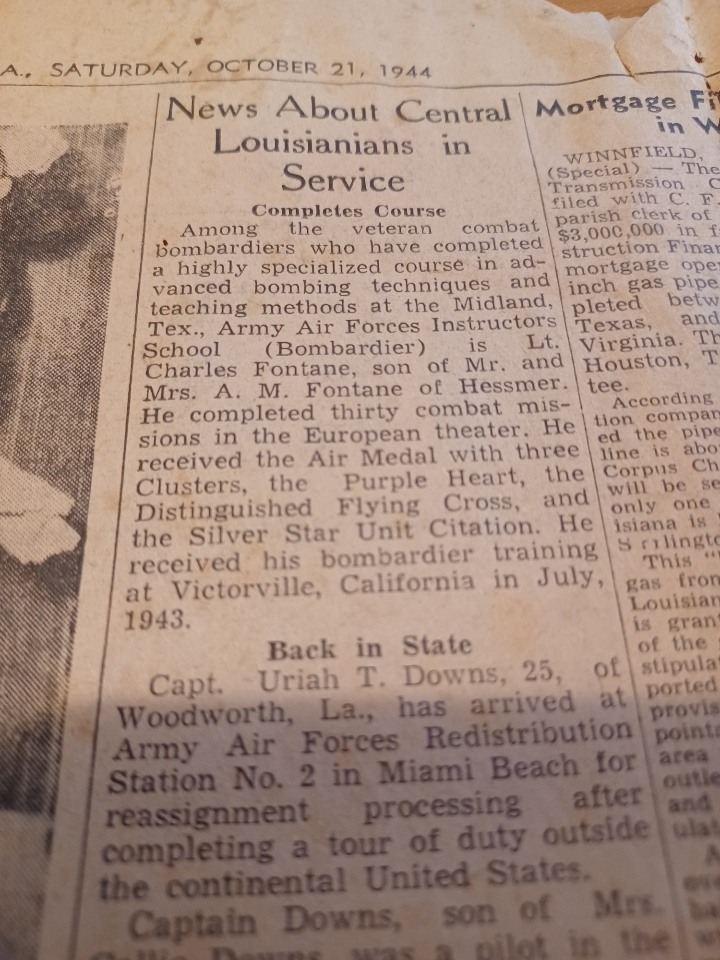
The Alexandria Town Talk newspaper featured a column entitled “News About Central Louisianians in Service” that reported news items focused on community residents serving in the military during World War II. The October 21, 1944, newspaper in the Louisiana Maneuvers and Military Museum collection includes an edition of the column that nominally reports on Pvt. Thomas Hank, then a patient at LaGarde Army/Navy Hospital in New Orleans. (LaGarde Hospital was constructed in 1941 on the New Orleans Lakefront to relieve overcrowding at regional Army hospitals, especially at Camp Beauregard in Pineville and Camp Shelby in Hattiesburg, Mississippi. It was classified as an “exempt station” not connected to any larger Army post. The Veterans Administration used the buildings for offices and other purposes after the war.)
Hank served in the Medical Corps as a stretcher-bearer (“corpsman” in the Navy or Marines, “medic” in the Army) and was assigned to the Italian Campaign for two months as American troops fought their way from Naples to Montero.
Newspaper writers used the opportunity presented by the snippet of news to remind readers of how important this service was, even though few people thought of the vital role played by those who transported wounded soldiers for treatment.
Calling the corpsmen and medics “seldom mentioned and unsung heroes of the present war,” writers commented that “Although unarmed, these stretcher-bearers are continually at the front lines and in the thick of the battle. One of the reasons for 97 men out of every 100 wounded coming home is credited to these courageous medical corpsmen. Too much praise cannot be given the men of the group.”
“Private Hank refrained from reciting any pf his personal experiences, stating that this was not done by corpsmen.”
“In the course of his work, Private Hank said that he was often held up by German patrols, who, after determining he was unarmed and a bona-fide corpsman, would release him.”
The Geneva Conventions required that doctors, medics, nurses, or corpsmen had to be unarmed and had to display a red cross on their uniform or helmet to show that they were noncombatants. In return, they were not to be attacked. Both sides in the European Theater generally observed the rule, but there was no guarantee.
Historians recognize that corpsmen and medics played a significant role in the war. They received comprehensive training to prepare them to provide advanced first aid and immediate medical care on the battlefield. They had to learn how to transport wounded soldiers without causing additional complications to their wounds. They also had to complete weapons and combat operations training because of their proximity to battlefields. Pacifists and recognized conscientious objectors were allowed to skip weapons training, but they had to complete all other required physical and medical training.
They carried out many of their battlefield responsibilities while under enemy fire, conditions that led to corpsmen and medics dying in battle even though some were pacifists. About 330 corpsmen died during the Battle of Iwo Jima, for example. Seven corpsmen received the Medal of Honor for their outstanding bravery during World War II, more than had received the award during any previous American war.