
Jerry Sanson
Louisiana Maneuvers and Military Museum
January 2026

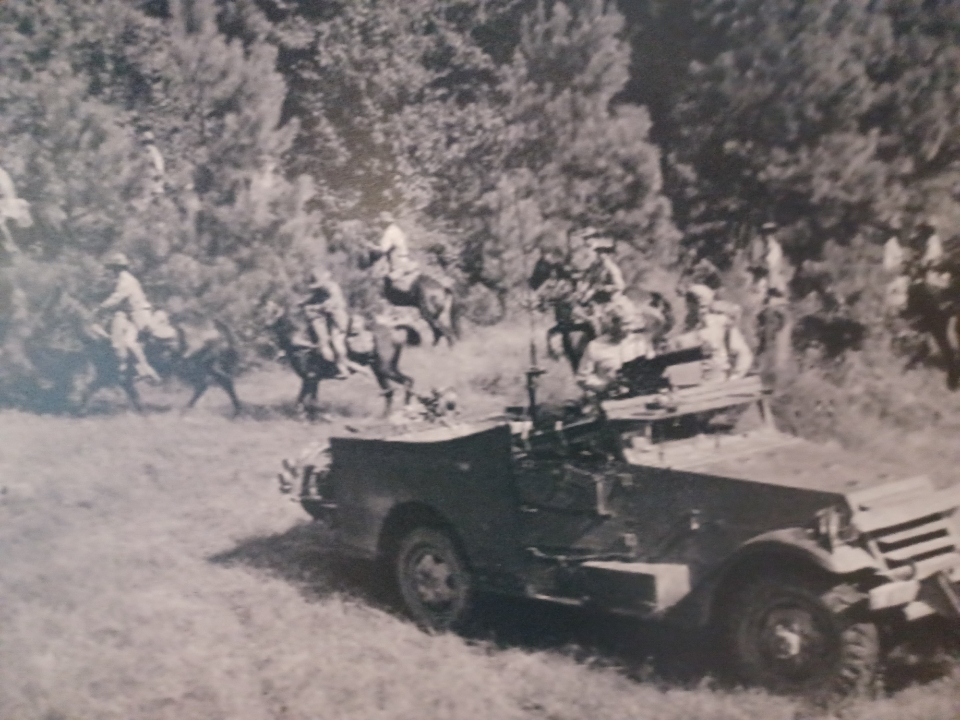
The Louisiana Maneuvers and Military Museum displays a horse wearing the saddle and bridle of the 1940 and 1941 Maneuvers eras and an accompanying human mannequin wearing a summer uniform of a mounted Cavalry officer. Why do we have a mannequin of a horse in a museum dedicated to telling the story of a mechanized war? The question is answered by a photograph displayed in the same gallery. The early 1940s was a time of transition in the US Cavalry from the traditional horse-mounted soldier to the motorized Cavalry. The picture shows horse mounted Cavalry training in the background while soldiers training in a mechanized vehicle in the foreground represent the future of the Cavalry.
The Army moved toward mechanization during the late 1930s, and most horse- or mule-drawn units were motorized by 1938. Even though many commanders reluctantly accepted mechanized transportation, they continued to maintain that horse Cavalry had proven itself on the battlefield in ways that the new tanks and other equipment had not.
One of the objectives that General George Marshall wanted to explore in Central Louisiana during the 1940 Maneuvers was whether or not a mechanized Cavalry could serve as well as the old horse Cavalry to meet the Army’s needs. General Stanley Embick’s conclusion was not good for the horses. He reported in his assessment of the exercise that the mechanized Cavalry could accomplish the Army’s goals. General George Patton sealed the fate of the horse Cavalry during the 1941 Maneuvers when his mechanized units encircled the entire opposing army ahead of schedule, settling the issue and ensuring a future mechanized Cavalry.
The 26th Cavalry in the Philippines continued to use horses despite the Army’s findings primarily because of oversight and distance
from Washington. They were one of the few regiments still mounted on horses when the United States entered World War II after the Pearl Harbor attack.
War Plan Orange-3 called for American and Filipino troops to withdraw to the Bataan Peninsula if overwhelmed by a Japanese invasion where they would maintain control of the entrance to Manila Bay until they were relieved by US Naval Forces. General Douglas MacArthur, however, ordered the dispersal of supplies from Bataan to other locations in anticipation of an aggressive attack on any invading Japanese forces, leaving Bataan with meager supplies for the approximately 90,000 troops and 30,000 civilians who retreated there after MacArthur activated Orange-3 on 23 December 1941.
Meanwhile, Lt. Gen. Masaharu Homma led the Japanese invasion of the Philippines on 22 December. His battle-hardened troops headed toward Manila despite American and Filipino resistance. Capt. Clinton Pierce and his 26th Cavalry Regiment fought in the battles to delay the Japanese advance so other units would have time to withdraw to Bataan and organize its defenses.
General Jonathan Wainwright, commander of the North Luzon Force, wanted to anchor a defensive line in the village of Morong in mid-January 1942 to hold back the advancing Japanese troops and needed an advance guard to hold the village until reinforcements arrived. Lt. Edwin Ramsey, a platoon commander in the 26th Regiment, volunteered for the assignment.
Morong appeared deserted when Ramsey and his platoon of 27 mounted troops approached it on the morning of 16 January 1942, but shots rang out when the first Cavalrymen rode into the village square. Japanese troops had crossed the Batalan River bordering the village, and hundreds more were following them.
Ramsey ordered his men into formation, raised his pistol, and yelled the classic “Charge” horse Cavalry command, thus beginning the last horse Cavalry charge in Army history. He described the sight in his 1991 memoir: “Bent nearly prone across the horses’ necks, we
flung ourselves at the Japanese advance, pistols firing full into their startled faces. A few returned fire, but most fled in confusion, some wading back into the river, others running madly for the swamps. To them we must have seemed a vision from another century; cheering, whooping men firing from the saddles.”
Ramsey and his men scattered the Japanese troops and held Morong for five hours under heavy fire until reinforcements arrived. Three of Ramsey’s men were wounded; none died.
Despite this victory, the Japanese advance inexorably closed in on Bataan. Rations were critically low by early March, and the horses were starving because their food had run out. General Wainwright ordered the slaughter of all Cavalry horses. The troops who trained as horse soldiers were devastated. As one of them remarked, “There’s a special bond, and we were the last to share it.”
The 26th Regiment was split into a motorized rifle unit and a mechanized force with a few scout cars after losing their horses. The final hoofbeats of a US horse Cavalry charge lived on only in the memories of the men who had staged it.