Jerry Sanson
Louisiana Maneuvers and Military Museum
June 2026

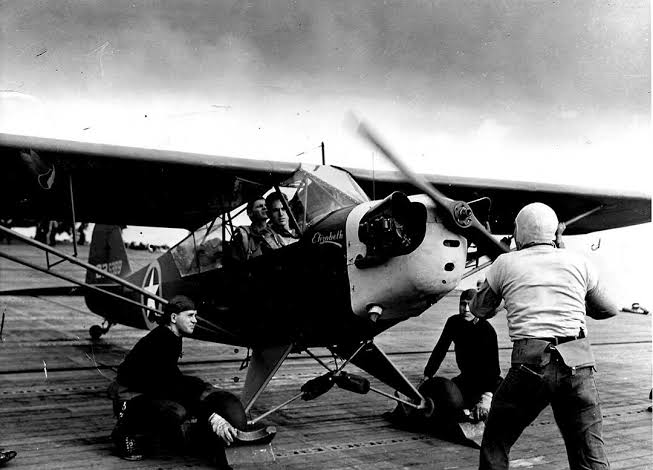
The United States military used different sizes of equipment as it fought its way across Africa, Europe, and the vast areas that it covered in the Pacific during World War II. One of the most unusual was the Piper J-3 Cub, a small fabric- covered airplane manufactured by Piper Aircraft between 1938 and 1947 that was known as the L-4 in its miliary configuration. All branches of the military used the bantam plane mainly for unarmed observation, artillery-spotting, pilot training, and liaison flights. The military bought more than 5,600 of them during the war. The plane’s small size and light weight allowed it use short front-line landing areas that hardly qualified as airstrips in their unimproved state.
A few figures demonstrate how diminutive the Grasshopper was. The wingspan was 35 feet 3 inches, the length was 22 feet 5 inches, height measured at 6 feet 8 inches, it weighed 1,200 pounds unloaded, and its Continental A-65-8 engine produced only 65 horsepower. Its cruising speed was 73 miles per hour, and its ceiling was 11,500 feet.
L-4 was the general name for the aircraft, but each military branch designated its version by its own name:
L-4 Grasshopper U.S. Army
NE -1 Navy
NE -2 Marines
TG-8A glider training version
O-59 original observation designation before L prefix was adopted .
L-4s were not usually armed but two instances when they were left stories that create interesting history. History teacher Charles “Bazooka Charlie” Carpenter abandoned his classroom to fight Nazis during the war. Unsatisfied with his role of flying an unarmed observation plane, he mounted 6-8 bazookas on the struts his plane, “Rosie the Rocketeer,” and bounced down the runway to hunt German armor. He is credited with destroying six German tanks and other vehicles, equipment, and supplies by the end of the war. His awards include the Silver Star, Bronze Star Medal, Air Medal with Oak Leaf Cluster, European-African-Middle Eastern Campaign Medal with 4 campaign stars, American Campaign Medal, and World War II Victory Medal, all won in an officially unarmed airplane that could cruise at only 73 miles an hour.
The other story involves L-4 pilot Lt. Duane Francies and observer Lt. William Martin. These two soldiers took off on the morning of April 11, 1945, for a routine scouting flight for the American 5th Armored Division. They followed a German motorcycle speeding down a road out of curiosity about 100 miles west of Berlin when they spotted a German Fiesler Fi 156 Storch flying just above the treetops. Not wanting the German plane to locate and report the presence of the 5th Division, Francies and Martin decided to attack using the only weapons available on board—their standard issue M-1911 Colt 45s. Francies flew so close to the Storch that he later reported, “The two planes were so close I could see the Germans’ eyeballs, as big as eggs, as we peppered them.” The Storch pilot dug one of the plane’s wingtips into the ground and crashed. Francies and Martin landed and took the two Germans in the Storch crew prisoner.
The final air-to-air combat between the United States and Nazi Germany was over, and it was fought by two unarmed planes. It was won by two Americans with pistols.
The Louisiana Maneuvers and Military Museum displays a large model of an L-4. Referees used the plane, marked with a white cross as is the model, to observe troop movements and the outcome of combat during the training exercises.