
Jerry Sanson, Louisiana Maneuvers and Military Museum
June 2026
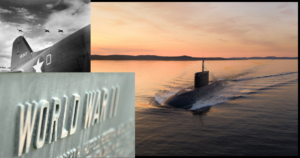
The Louisiana Maneuvers and Military Museum exhibits an information board focused on German submarines that operated in the Gulf of Mexico during World War II. Their presence was the subject of rumors; people spotted mysterious shapes in the water; military patrols found evidence of their presence; and they sank ships in the Gulf, confirming that Germany had carried the war to the Gulf.
German Chancellor Adolf Hitler ordered rearmament in 1935 in violation of the Treaty of Versailles, and Britain in effect recognized the re-creation of a German Navy, eventually the Kriegsmarine (War Navy) by negotiating the Anglo-German Naval Agreement in June 1935, allowing Germany to build a fleet up to 35% of the total size of the Royal Navy.
Hitler appointed Admiral Karl Donitz to command the new Unterseeboot (U-boat) division of the fleet. Donitz quickly deployed his submarines against ships bound for England after the war began in 1939, targeted ships bound for the Soviet Union after Germany declared war against it in June 1941, and expanded their threat to include the United ‘States following mutual declarations of war in December 1941.
The German Navy brought the war to American coastal waters in search of Allied shipping by initially targeting ships along the eastern coastline. Casualties began accumulating on January 12, 1942, and U-boats sank 62 Allied ships off the east coast by the end of the month. U-boats expanded the attack when the first one (U-507) entered the Gulf of Mexico in May 1942. The number reached six by the end of the month.
The U-boats evidently claimed their first victim on June 12, 1942, when four torpedoes struck and sank the SS Cities Service Toledo just south of Marsh Island, Louisiana. The US Coast Guard, already stretched thin in its assignment to keep coastal areas safe, recruited Louisiana coastal residents from south of Lake Charles to south of New Iberia to stand lookout for suspicious activity. Members of the “Cajun Coast Guard,” as it was originally known, received $21 per month for their vigilance.
Even though they never spotted a U-boat, members of the Cajun Coast Guard rescued crew members from a downed B-26 as they slowly and painfully made their way through sawgrass and mosquitoes in a marsh seeking help. Thereafter, the Cajun Coast Guard acquired the name “Swamp Angels” which stuck to the organization until the end of the war.
The Coast Guard also established lookout stations with observation towers staffed 24 hours a day about 12 miles apart along the Louisiana coast and created an Armed Guard School at the New Orleans Naval Station. Meanwhile, the Navy installed and staffed 3” and 5” guns on merchant vessels and experimented with using blimps operated from the Houma-Terrebonne Airport to help combat the possibility of German attacks.
U-166 was the most famous U-boat that operated in the Gulf, its fame resting on the facts that it is the only known submarine that sank in the Gulf during the war, and it was discovered about sixty years later. German radio logs reveal that the last radio signal from U-166 was received on July 28, 1942, shortly after it set nine mines off the Southwest Pass jetty at the mouth of the Mississippi River.
The circumstances of U-166’s destruction are disputed. The initial report credited pilot Henry White and co-pilot George Boggs who flew their Grumman J4F-1 Widgeon patrol plane out of Houma airport on July 30, 1942, on a routine mission looking for submarines. Their mission changed dramatically when they spotted a submarine on the Gulf’s surface about 30 miles from Last Island. Observation told them that the U-boat crew had spotted them as well. Fearing for their safety, White brought the Widgeon within 250 feet of the surface while the U-boat began to dive. Boggs released a depth charge that exploded close to the boat, bringing it and its 52-man crew and their captain to rest on the floor of the Gulf.
Later analysis led the US government to determine that credit for the sinking should have gone to submarine chaser PC-566. Captain Herbert Claudius had reported an encounter between his vessel and a U-boat close to the time of the Widgeon attack, but he was not believed until evidence provided by studies of the position of wreckage of U-166 supported his account rather than the White and Boggs version. Did the attacks occur sequentially? Was U-166 damaged by one of the attacks to the point that the other found it easier to sink the sub? Was the sub spotted on the surface because the crew was inspecting damage from an earlier attack? These are unanswered questions in an intriguing story.
U-166 rested in the dark waters of the Gulf until 2001 when archaeologists Robert Church and Daniel Warren found the wreckage of its last victim SS Robert E Lee and then stumbled across a debris field and two large sections of U-166 less than two miles away while conducting an archeological survey prior to construction of an underwater pipeline. The site was designated as a war grave to prevent any salvage operations that would disturb the final resting place of 52 men and their captain.
Even though civilians along the Gulf Coast know little, if anything, substantive about the German presence, about 25 unterseeboots of the Kreigsmarine sank ships, took Allied civilian lives, and threatened shipping in the Gulf of Mexico for about seven months during 1942 until American defensive efforts made their continued presence too dangerous for the subs and their crews.
